Preservation Issues

Top Ten Stories of 2010


Moynihan Station


329 MacDonough Street


Tifereth Israel: Architects Roz Li and Harold Martinez of Li/Saltzman Architects, accompanied by James Thorsen of DDC and Karen Ansis of Conservancy, lead pre-bid walk-through


Erasmus Academy Building


Historic Synagogue Fund: Leaking roof at the Astoria Center of Israel. photo by Cutsogeorge Tooman & Allen Architects, P.C.


Conservancy visits world trade center ship remains


Conservancy rallies to keep historic sites open


State expands preservation tax credits


Supporters of Coney Island’s historic buildings found good, bad news in 2010


Living Landmark Honorees Marlo Thomas and Phil Donahue sing their own version of "Makin' Whoopee" with words by Ms. Thomas.

1. Moynihan Station Groundbreaking

The Conservancy has been at the forefront of the push for Moynihan Station since Sen. Moynihan first proposed turning the landmark Farley Post Office into a train station in 1993.

This year marked a major milestone as the Conservancy helped secure $83.3 million in federal funding for Phase One of the project and officials announced groundbreaking of Moynihan Station at the steps of Farley Post Office.

Federal Transportation Secretary Ray LaHood joined Gov. Paterson, Mayor Bloomberg, U.S. Senators Kirsten Gillibrand and Charles Schumer, and Congressman Jerrold Nadler among others in announcing that vital underground work that will expand the connection from the current Penn Station into tracks under Farley as well as new ventilation and exits will begin soon. The late Senator Daniel Patrick Moynihan’s wife Elizabeth Brennan Moynihan and daughter, Maura Moynihan, also took part in the ceremony.

2. Conservancy’s Emergency Intervention Saves Historic Brownstones

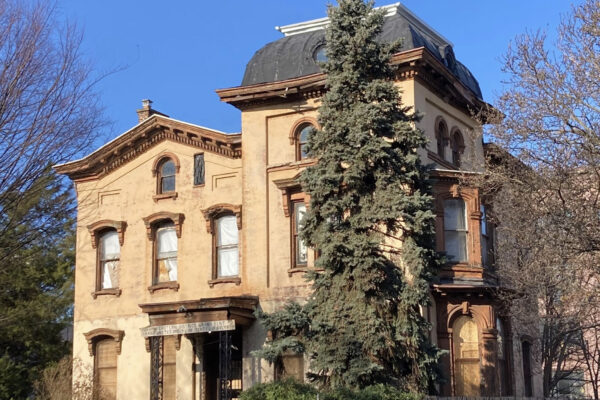
Emergency intervention by the Conservancy’s Technical Director, Alex Herrera, at 329 MacDonough Street in Brooklyn helped save four historic brownstones from demolition.

Improper excavation work in a cellar of one building led to a partial party wall collapse with a neighbor. The Department of Buildings inspected the two houses that share the common basement wall and immediately ordered their evacuation as well as the evacuation of two other adjacent buildings. They then ordered an immediate demolition of the first two buildings, with the possibility that all four might need to be razed, citing the danger of “imminent catastrophic collapse.”

The circa 1870 houses were designed by prolific Brooklyn architect Amzi Hill and are part of the Stuyvesant Heights Historic District. MacDonough Street is one of the most architecturally distinguished streets in the borough.

The owner of 329, an attorney, obtained a temporary restraining order, which bought some time. Alex Herrera was called in and he engaged an engineer and expert shoring contractor. Working together with DOB personnel, a suitable design was developed that preserved both homes and after a temporary displacement, all effected families are back in their homes.

3. Congregation Tifereth Israel Groundbreaking Anticipated in Early 2011

After more than a decade of financial and technical assistance by the Conservancy, we expect groundbreaking on the restoration of Queens’ oldest synagogue, Congregation Tifereth Israel in early 2011.

As the project took shape Tifereth Israel engaged the Conservancy as its project manager for a $1.3 million project that would remove the stucco coating and re-clad the building with wood, as well as restore all of its windows, decorative, and religious details. Among the many pre-development tasks carried out in recent years on behalf of the synagogue, Conservancy staff Karen Ansis and Ann Friedman coordinated the processing work with the various public funding sources and the completion of plans and specification by the firm of Li/Saltzman Architects.

Philanthropist Arnold Goldstein closed a $275,000 funding gap and a developer was selected in 2010. Work will begin following the City’s final approval.

4. Milestones Reached in Erasmus Academy Building Restoration

The Conservancy’s efforts to save The Erasmus Academy Building had two milestones in 2010: the completion of a conditions survey and the awarding of a $300,000 state matching grant.

The Erasmus Academy Building is an unattached, wood-frame building dating from 1787 and the first secondary school chartered by the New York State Board of Regents. Aaron Burr, Alexander Hamilton, Peter Lefferts, and Robert Livingston were among its founders. This building was one of the earliest designated as a City landmark in 1966, shortly after the New York City Landmarks Preservation Commission was formed. It is also listed in the National Register of Historic Places.

Erasmus Hall High School, a huge masonry quadrangle of connected buildings, was built around the Academy from 1905 through 1940. A designated landmark also, Erasmus boasts dozens of illustrious alumni, including entertainers Barbra Streisand, Lainie Kazan, Neil Diamond, Betty Comden, Beverly Sills, Barbara Stanwyck, Eli Wallach, and Susan Hayward; writers Bernard Malamud and Mickey Spillane; builder Sam Lefrak, former New Jersey Governor James Florio, sports figures, scientists, and many more.

During the 20th century, the Academy was used less and less as classroom space and more and more as administrative offices, a library, and a museum. It has been vacant for over 10 years now and in great need of stabilization and restoration work. As there is no City funding available for non-classroom space properties, the Landmarks Conservancy began a campaign to preserve the Academy, with the support of the City’s custodial agency for the building, the Department of Education, and in collaboration with the Erasmus Alumni Association.

Funding for the conditions survey was provided by the 42nd Street Fund, the National Trust of Historic Preservation’s Elizabeth and Robert Jeffe Foundation Fund for New York City, the Conservancy and the Rockefeller Foundation. It was provided by the firm of Cutsogeorge Tooman & Allen Architects, which estimated the exterior restoration costs at $2.2 million for construction alone.

Prior to the completion of the conditions report, the Conservancy drafted an application for State Environmental Protection Fund money on behalf of the City. As a result, the State awarded a $300,000 matching grant for the project—a good start to the capital campaign that the Conservancy will spearhead in 2011 to secure the public and private funds needed for the exterior restoration of the Academy building.

5. Conservancy Receives Major Gift to Help Launch New Historic Synagogue Initiative

The David Berg Foundation awarded a two-year, $100,000 grant in 2010 to help establish a new Historic Synagogue Fund. The Fund allowed, for the first time, the Conservancy to make Challenge Grants of between $25,000 and $50,000 to assist major synagogue repair and restoration projects in New York City. Click here to learn more.

We’ve now given two grants: The first was a challenge grant of $40,000 to the Free Synagogue of Flushing, and the second was a challenge grant of $30,000 to the Astoria Center of Israel. Click here to learn more.

6. Conservancy Visits World Trade Center Ship Remains; Lead Archeologist Talks About Find at Professional Circle Breakfast

Conservancy staffers got a first-hand look at an extraordinary discovery at the Ground Zero construction site—the hull of what is presumed to be an 18th century ship uncovered there this year. The find generated headlines around the world and continues to reveal new information about New York’s nautical history and the physical development of lower Manhattan. Click here to read the full story.

Not long after the Conservancy visited the site, Professional Circle members filled the Conservancy’s conference room to hear Michael Pappalardo of the consulting firm AKRF, Inc. talk about his experience as lead archeologist involved in the astonishing discovery. Click here to read the full story.

7. Conservancy Rallies to Keep Historic Sites Open

The Conservancy helped rally support for the state’s historic sites when state budget cuts threatened to close important building connected to our Founding Fathers. While the legislature found a way to keep the sites and some state parks open, an adequate budget is going to be an issue again in 2011. We will continue to work to protect the state’s extraordinary historic legacies.

8. State Expands Preservation Tax Credits

After intense lobbying by the Conservancy and colleague groups the state modestly expanded who is eligible for state homeowner and commercial preservation tax credits and made them easier to use for developers. Protecting the tax credits will again be an issue in 2011.

9. Supporters of Coney Island’s Historic Buildings Found Good, Bad News in 2010

The Conservancy, along with a coalition of preservation and advocacy groups scored a victory earlier this year when the New York State Historic Preservation Office determined that an historic district was merited on Coney Island. The historic buildings lining Surf Avenue are at the heart of the District, which goes down to the Boardwalk and includes landmark amusements, such as the Cyclone and the Parachute Jump.

However, even with this recognition, several of the historic buildings have been lost and others are threatened with demolition. The 1920’s Bank of Coney and the 1903 Shore Hotel were torn down this fall. The vacant lots owned by Thor Equities are a sad memorial to Coney’s historic past. Henderson’s Music Hall and the Grashorn Theater, two other buildings owned by Thor Equities are now under threat.

Good news came from the Landmarks Preservation Commission, which designated the Shore Theater as an individual landmark in its last hearing of the year in December. The Coney Island advocacy community is still waiting for a vote on the (former) Childs Restaurant building, which now houses the non-profit community group Coney Island USA. (click here to read the Conservancy’s statement of support).

New amusements and rides brought huge crowds to Coney in summer 2010. The Conservancy is working to ensure that in summer 2011, visitors will be able to experience not only the thrills of a roller coaster but the fascinating story of Coney Island’s history.

At year’s end Conservancy Board Member Tony Goldman, an expert at reviving historic buildings, is taking the lead in saving what’s left of Coney.

10. Living Landmarks Celebration, Chairman’s Award and 20th Lucy G. Moses Preservation Awards

The Living Landmarks Celebration at the Plaza, Nov. 3, was “an evening of great fun, with an extremely serious objective: saving our city” said David Patrick Columbia of The New York Social Diary. This year marked the 17th Gala and one of the most successful raising more than $800,000 and packing the Plaza Ballroom, which was landmarked through our efforts.

This year’s honorees were Graydon Carter, Howard Dodson, Larry Silverstein, Marlo Thomas and Phil Donahue, Jonathan Tisch and Bunny Williams. They responded with songs and heartfelt tributes to the City and its landmarked buildings. Living Landmark host Liz Smith and Living Landmark bandleader Peter Duchin once again made it a festive and lively evening.

More than 200 people turned out to honor Robert Selsam of Boston Properties at the Conservancy’s Chairman’s Award luncheon on September 23 at The Harvard Club. The event raised a record $100,000.

April marked the 20th Lucy G. Moses Preservation Awards, which are the Conservancy’s highest honors for outstanding preservation efforts. Hundreds packed the spectacular Milstein Hall of Ocean Life at the American Museum of Natural History, one of the honorees, to honor individual contributions to preservation and projects completed in 2009.

Robert Silman received the Preservation Leadership Award for his achievements in the preservation-engineering field in a career spanning over 50 years. Kenneth Cobb received the Public Leadership Award for his work at the Municipal Archives. This year’s project award recipients included: High Line, Beacon Theatre, American Museum of Natural History, Empire State Building Lobby, 36 Grace Court, Convent of the Sacred Heart School, Flushing Friends Meeting House, MacIntyre Building, Park Lane at Sea View, Roosevelt House and St. Andrew’s Episcopal Church.

Click here to sign up for the Conservancy’s monthly Enewsletter.